
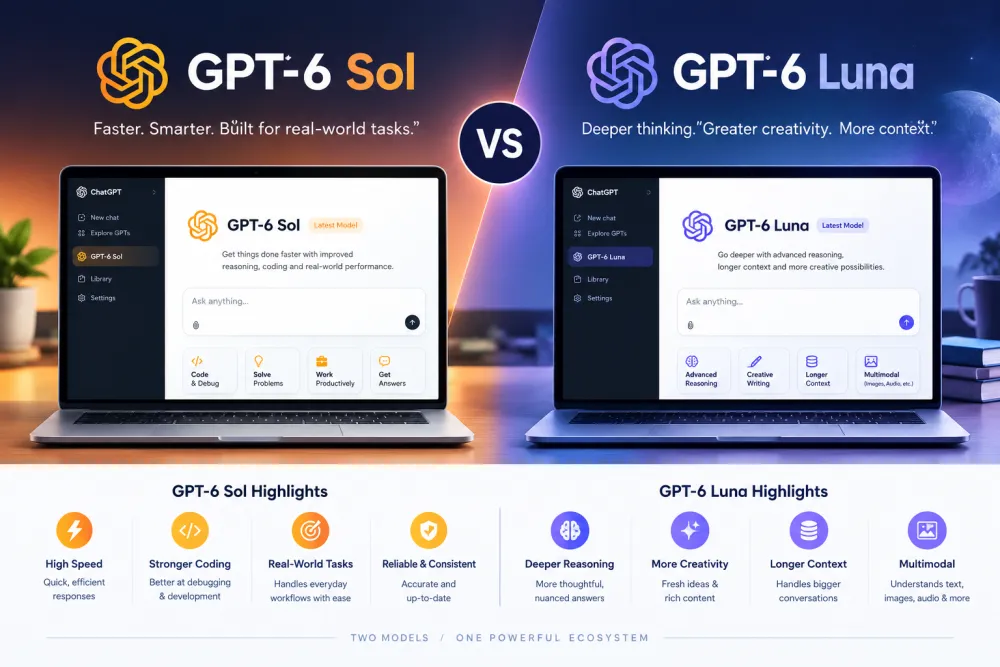
OpenAI has expanded its GPT-6 model family with two new models: GPT-6 Sol and GPT-6 Luna. Launched on September 22, 2026, the two models are designed for different types of workloads.
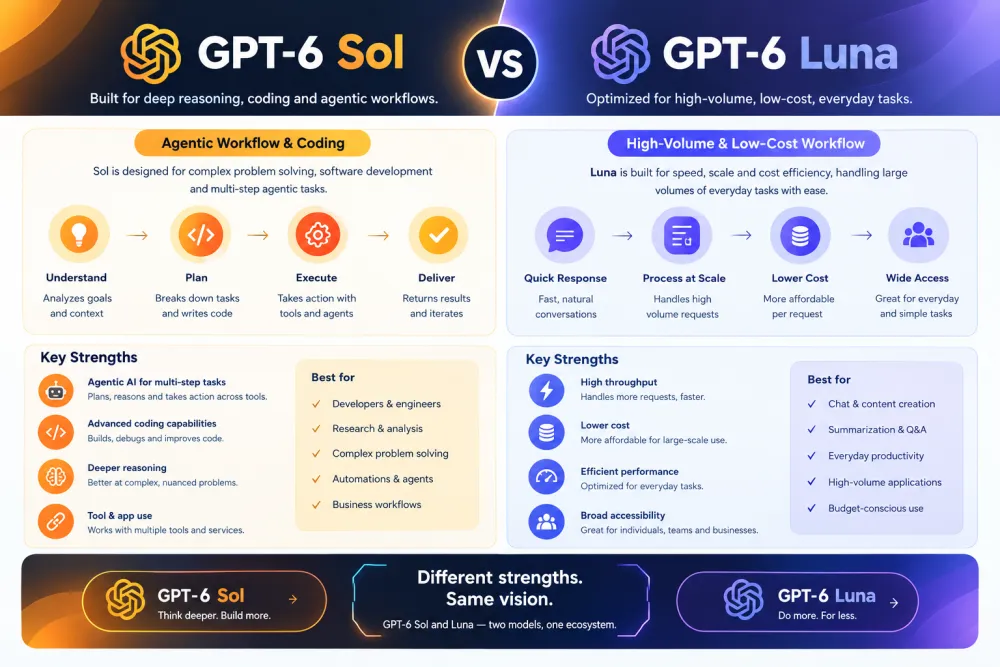
GPT-6 Sol focuses on more demanding coding and agentic workflows, while GPT-6 Luna is designed for focused, high-volume tasks where keeping operating costs low is important.
Both models support text and image inputs, text output, reasoning capabilities, a 1.05 million-token context window, and access through OpenAI's API.
But which one should developers use? In this guide, we will compare GPT-6 Sol vs GPT-6 Lunabased on features, pricing, context window, coding, speed and practical use cases.
We will also explain how to access and use both models.
What Are GPT-6 Sol and GPT-6 Luna?
GPT-6 Sol and GPT-6 Luna are part of OpenAI's GPT-6 model family.
OpenAI positions GPT-6 Sol as a model for complex coding and agentic workflows. It is intended for tasks where users need stronger reasoning and the ability to handle more demanding work.
GPT-6 Luna, on the other hand, is positioned as an efficient model for focused, high-volume workloads. It is designed for applications where a large number of requests need to be processed economically.
The two models therefore aren't simply two versions of the same model with different speeds. Their main difference is the balance between capability and cost.
GPT-6 Sol vs GPT-6 Luna: Quick Comparison
Feature
GPT-6 Sol
GPT-6 Luna
Model ID
GPT-6-sol
GPT-6-luna
Main focus
Complex coding and agentic workflows
Focused, high-volume tasks
Input price
$2 / 1M tokens
$0.10 / 1M tokens
Output price
$10 / 1M tokens
$0.50 / 1M tokens
Cached input
$0.20 / 1M tokens
$0.01 / 1M tokens
Context window
1.05M tokens
1.05M tokens
Maximum output
128K tokens
128K tokens
Text input
Yes
Yes
Image input
Yes
Yes
Function calling
Yes
Yes
Structured outputs
Yes
Yes
Web search
Supported
Supported
File search
Supported
Supported
Computer use
Supported
Supported
GPT-6 Sol Features
GPT-6 Sol is aimed at workloads where a developer needs more capable reasoning without moving all the way to OpenAI's flagship GPT-6 Astra.
1. Complex Coding
One of the major use cases for GPT-6 Sol is coding.
OpenAI says Sol was built to power complex coding and agentic workflows. It can therefore be useful for tasks such as:
1. Debugging larger codebases
2. Writing and modifying application code
3. Working with coding agents
4. Reviewing code
5. Generating tests
6. Refactoring existing code
7. Handling multi-step development tasks
OpenAI also reports improvements over GPT-5.6 Sol on its Frontier Code evaluation.
2. Agentic Workflows
Sol is designed for workflows where an AI model needs to perform multiple steps rather than simply answer one question.
For example, a developer could use an agent to:
1. Understand a software requirement
2. Inspect existing files
3. Modify code
4. Run testsIdentify errors
5. Make corrections
Prepare the final changesThis makes Sol particularly relevant for AI-powered development tools and automation systems.
3. Reasoning Options
GPT-6 Sol supports multiple reasoning levels, including none, low, medium, high, xhigh and max, depending on the API configuration and use case.
This gives developers more control over the trade-off between reasoning effort, response time and cost.
GPT-6 Luna Features
GPT-6 Luna takes a different approach.
Instead of targeting the most demanding workloads, OpenAI describes Luna as its most efficient model for focused, high-volume tasks.
1. High-Volume Processing
Luna can make sense when an application needs to process a large number of relatively focused requests.
Examples include:
1. Text classification
2. Summarization
3. Data extraction
4. Customer-support workflows
5. Content transformation
6. Basic document processing
7. Repetitive AI automation
For these workloads, API cost can become a major factor.
2. Very Low API Cost
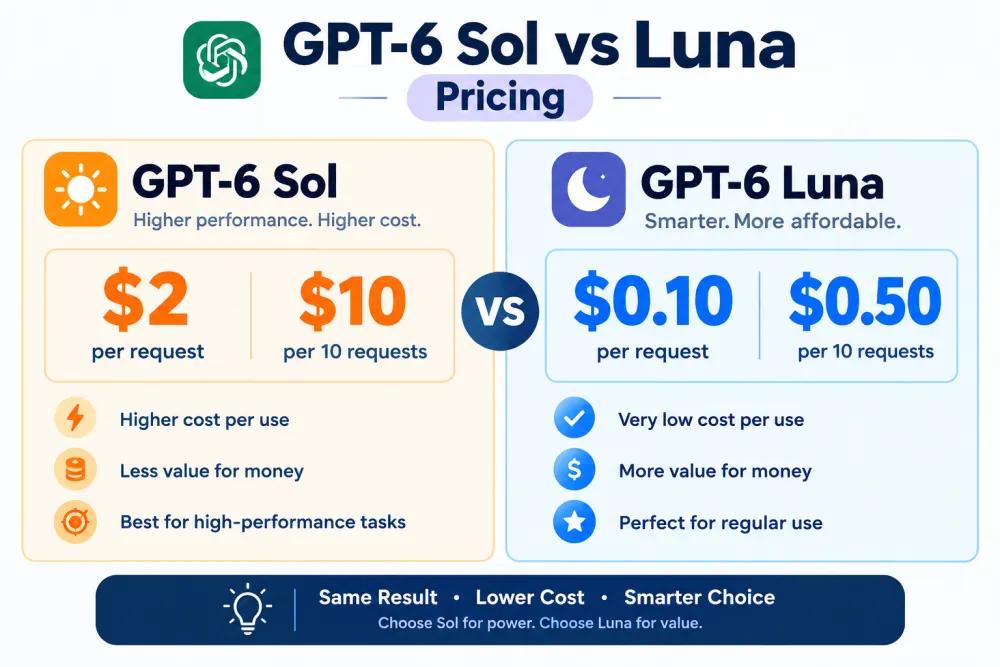
The biggest difference between Sol and Luna is pricing.GPT-6 Luna costs:
$0.10 per 1 million input tokens
and
$0.50 per 1 million output tokens.
That makes Luna significantly cheaper than Sol for applications processing large volumes of tokens.
GPT-6 Sol vs GPT-6 Luna Pricing
Model
Input / 1M tokens
Output / 1M tokens
GPT-6 Sol
$2
$10
GPT-6 Luna
$0.10
$0.50
GPT-6 Sol therefore costs 20 times more than Luna for input tokens and 20 times more for output tokens at the standard rates listed by OpenAI.
However, price alone does not determine which model should be used.
The appropriate choice depends on the complexity and volume of the workload.
GPT-6 Sol vs Luna: Context Window
Both GPT-6 Sol and GPT-6 Luna have a 1.05 million-token context window and support up to 128K output tokens according to OpenAI's model comparison documentation.
A large context window is useful when an application needs to work with substantial amounts of information in a single request.
For example, developers can use a large context window when working with:
1. Large documents
2. Software repositories
3. Technical specifications
4. Business reports
5. Multiple files
6. Long conversations
So, in terms of context capacity, there isn't a major difference between Sol and Luna.
GPT-6 Sol vs Luna: Speed
Speed is a little more complicated than simply saying that one model is "X seconds faster.
"OpenAI's public model documentation does not provide a single fixed response-time number that applies to every workload. Actual response time can depend on factors such as:
1. Prompt size
2. Reasoning effort
3. Output length
4. API configuration
5. Server load
6. Streaming configuration
7. Workload complexity
Therefore, it would be misleading to claim that GPT-6 Sol always responds faster than GPT-6 Luna or vice versa.Instead, the practical difference is that Luna is optimized for efficient, high-volume workloads, while Sol is intended for more demanding coding and agentic work.
GPT-6 Sol vs GPT-6 Luna for Coding
If coding is the main requirement, Sol is designed specifically around complex coding and agentic workflows.
OpenAI reports that GPT-6 Sol improves substantially over GPT-5.6 Sol on its Frontier Code evaluation.
Luna can still be useful for simpler coding-related tasks, especially when a developer is processing many smaller requests.
For example:
Use Sol for:
1. Complex debugging
2. Large code changes
3. Multi-step coding agents
4. Repository-level work
5. Difficult technical tasks
Use Luna for:
1. Simple code transformations
2. Basic classification
3. Repetitive code-related processing
4. High-volume automated requests
GPT-6 Sol vs Luna for Business Automation
Both models can be useful for automation, but the workload matters.
Imagine a company processing 100,000 customer messages.If each message only needs simple classification or extraction, Luna's lower token cost can be attractive.
However, if an AI agent needs to inspect multiple systems, reason through complex information and perform multiple actions, Sol may be more appropriate.
The key question is therefore not simply:
"Which model is better?"Instead, ask:"How complex is my task, and how many times will I run it?"
How to Use GPT-6 Sol
GPT-6 Sol is available through OpenAI's API using the model ID:
GPT-6-solOpenAI's API changelog confirms that the model is available through the Responses API and Chat Completions API.
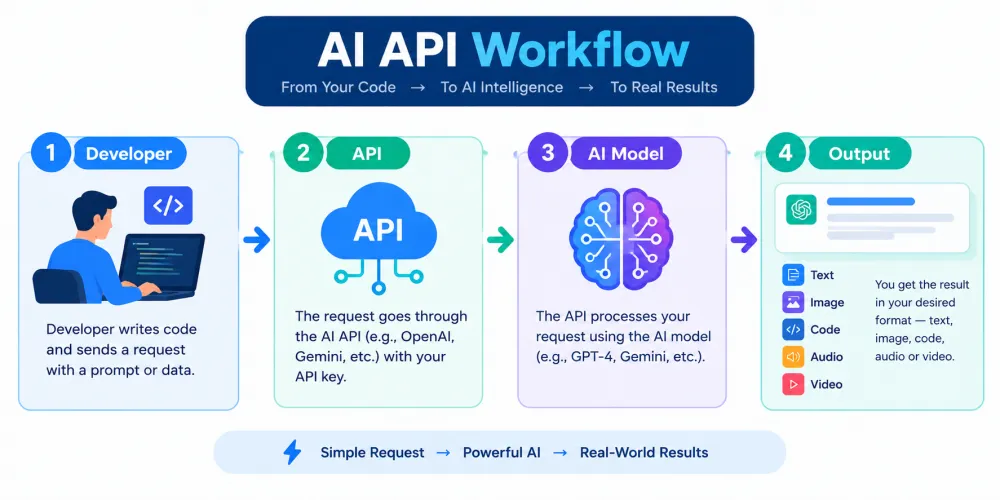
A basic API workflow is:
1. Create or access an OpenAI API account.
2. Create an API key.
3. Select the Responses API or Chat Completions API.
4. Set the model to gpt-6-sol.
5. Send your prompt.
6. Process the generated response.
Developers should check OpenAI's current API documentation before deploying the model because API parameters, limits and supported features can change.
How to Use GPT-6 Luna
GPT-6 Luna uses the model ID:
GPT-6-luna It is also available through the Responses API and Chat Completions API.
A typical workflow is similar:
Create an OpenAI API key.
Select the Responses API or Chat Completions API.
Choose gpt-6-luna.
Send the input.
Receive and process the response.
Luna can be particularly useful when the same type of AI request needs to be processed at large scale.
Are GPT-6 Sol and Luna Available in ChatGPT?
There is an important distinction here.OpenAI's September 22 ChatGPT release notes say GPT-6 Sol and GPT-6 Luna are available in ChatGPT Work and Codex, and that they are separate from the models available in regular Chat conversations.
Availability also depends on the user's plan, workspace settings and rollout access.
So, users should not assume that seeing GPT-6 Sol or Luna in the API means the same model will automatically appear in their normal ChatGPT model picker.
GPT-6 Sol vs GPT-6 Luna: Which One Should You Use?
The choice mainly depends on the type of workload.
Choose GPT-6 Sol when:
1. Your task involves complex reasoning.
2. You are building coding agents.
3. You need multi-step development workflows.
4. You are working with complex software projects.
5. You need stronger capability and can accept higher API costs.
Choose GPT-6 Luna when:
1. Cost efficiency is important.
2. You process large volumes of requests.
3. Your tasks are relatively focused.
4. You are building classification or extraction systems.
5. You need repetitive AI processing at scale.
OpenAI itself describes Sol as balancing intelligence and cost, while Luna is intended for cost-sensitive, high-volume workloads.
GPT-6 Sol vs GPT-6 Luna: Final Comparison
GPT-6 Sol and GPT-6 Luna are designed around two different priorities.
GPT-6 Sol and GPT-6 Luna are designed around two different priorities.
GPT-6 Sol targets more demanding coding and agentic workflows where capability is important.
GPT-6 Luna focuses on efficiency and high-volume workloads where keeping token costs low matters.Both provide a 1.05 million-token context window, 128K maximum output, multimodal input support and modern API capabilities.
The biggest difference is therefore the capability-to-cost trade-off.
For complex development and agent workflows, Sol is positioned for the heavier workload.
For large-scale, repetitive and cost-sensitive processing, Luna provides a much lower-cost option.
Before selecting a model for production, developers should test their actual workload with representative prompts and measure quality, latency and total cost.
Frequently Asked Questions
Is GPT-6 Sol better than GPT-6 Luna?
They are designed for different workloads. Sol targets complex coding and agentic workflows, while Luna is designed for focused, high-volume tasks.
How much does GPT-6 Sol cost?
The standard API price is $2 per 1 million input tokens and $10 per 1 million output tokens.
How much does GPT-6 Luna cost?
GPT-6 Luna costs $0.10 per 1 million input tokens and $0.50 per 1 million output tokens at the standard API rates.
What is the context window of GPT-6 Sol?
GPT-6 Sol has a 1.05 million-token context window and a maximum output of 128K tokens.
What is the context window of GPT-6 Luna?
GPT-6 Luna also has a 1.05 million-token context window and a maximum output of 128K tokens
Can I use GPT-6 Sol through the API?
Yes. OpenAI lists gpt-6-sol as available through the Responses API and Chat Completions API.
Can I use GPT-6 Luna through the API?
Yes. OpenAI lists gpt-6-luna as available through the Responses API and Chat Completions API.
Are GPT-6 Sol and Luna available in regular ChatGPT?
OpenAI's current documentation says Sol and Luna are available in ChatGPT Work and Codex, while regular Chat availability is separate and depends on the current model lineup, plan and rollout.
GPT-6 Sol and GPT-6 Luna expand the GPT-6 family with two different approaches to AI workloads.
Sol is aimed at complex coding and agentic work, while Luna focuses on efficient, high-volume processing.
Both models offer a 1.05 million-token context window and modern API capabilities, but their pricing is significantly different.For developers, the most practical approach is to evaluate the two models using real workloads rather than choosing only from benchmark numbers or price.
As OpenAI continues to update the GPT-6 family, pricing, availability and supported features may also change. Always check the latest OpenAI documentation before deploying a model in production.
Pingback: ChatGPT Dots: Features, How It Works, Uses & Availability