
Introduction
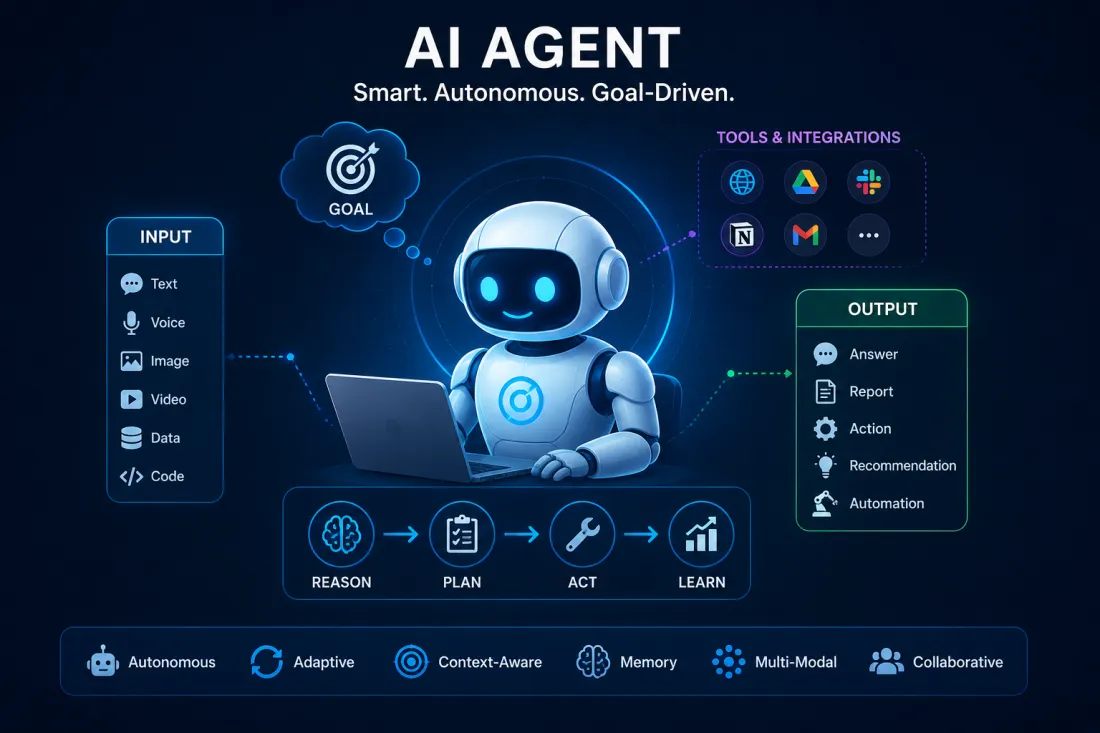
AI agents for beginners can seem complicated at first, but the basic idea is simple. AI agents are becoming increasingly useful because they can handle multiple steps of a task instead of only generating a single response, making people's jobs much easier.For beginners, the idea of an AI agent may seem daunting. However, the basic concept is simple: an AI agent receives a goal, determines the steps needed to work toward that goal, uses available tools when necessary, and delivers a well-organized result.For example, a standard chatbot might answer a question on a topic. An AI agent might take on a larger task, research information, organize the results, take action using connected tools, and deliver an organized result.In this guide, you'll learn what AI agents are, how AI agents work, examples of AI agents, AI agents vs. chatbots, useful AI agent tools, benefits, drawbacks, and how beginners can start using them.
AI Agents for Beginners: What Are AI Agents?
AI agentsare intelligent software systems designed to understand a goal, decide what to do, For AI agents for beginners the basic concept is simple and take action to complete a task with minimal human intervention.Unlike older AI tools, which typically respond to a single prompt, AI agents can handle multiple steps in a task. They can analyze information, create plans, use different tools, remember important information, and adjust their actions as the situation changes.Modern AI agents are powered by advanced generative AI and foundation models, which allow them to work with a variety of information. Depending on the system, an AI agent can understand and work with text, voice, images, video, audio, documents, and code.
ai agent explain with example:
instead of simply answering a question, an AI agent can research a topic, gather information from various sources, organize the results, create a report, and present the final result. This ability to reason, plan, act, and adjust makes AI agents useful for automating repetitive tasks and more complex business workflows.AI agents can also work with other AI agents or software tools. Multiple agents can break down a large task into smaller parts and coordinate their work to more efficiently accomplish the overall goal.
ai agent in Simple Word :
an AI agent is like a digital assistant that can not only understand what you want but also identify the necessary steps and take action to complete the task.
How Do AI Agents Work?
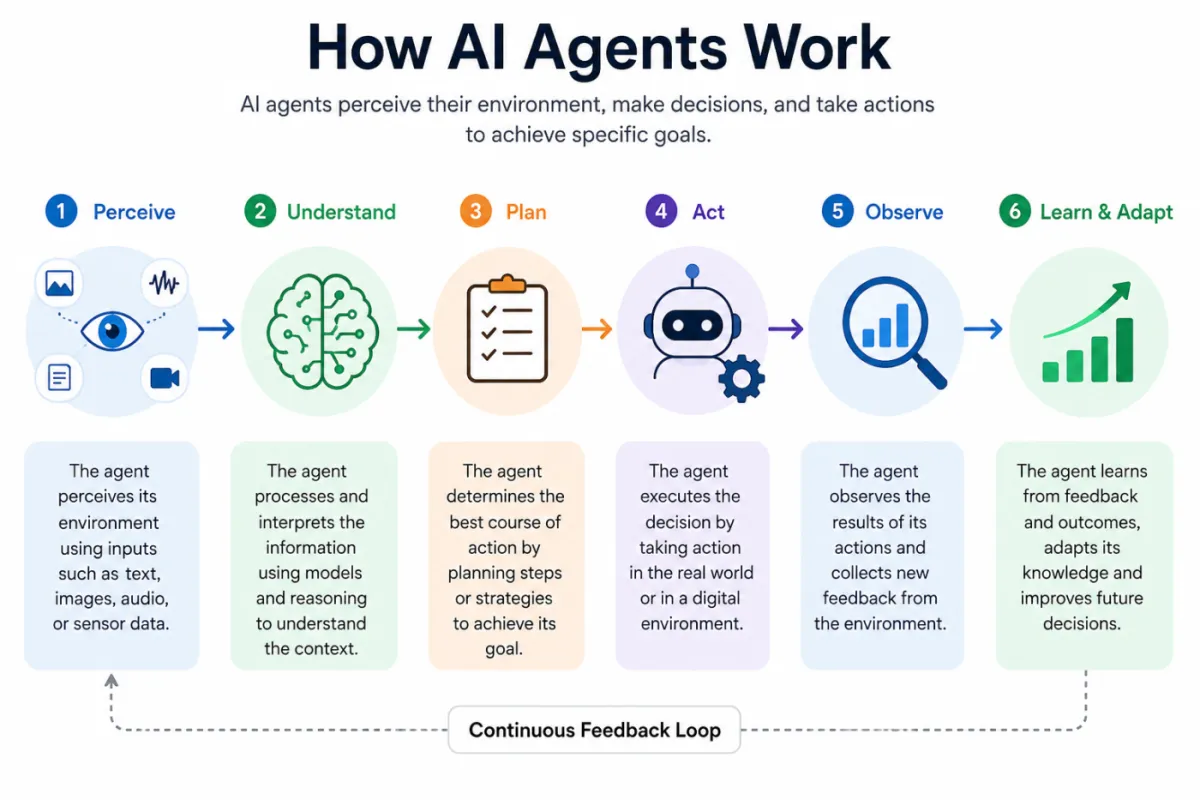
Understanding how AI agents work becomes easier when you think about them as a workflow.A typical AI agent can follow several stages.
1.The User Provides a Goal
Everything starts with an objective.For example:
“Research the latest information about AI tools and create a summary.
”The agent first needs to understand what the user wants to accomplish.
2.The Agent Plans the Task
Instead of immediately producing an answer, an agent may divide the larger task into smaller steps.
For example:
Research topic → collect information → organize information → analyze → create summary
3.The Agent Uses Tools
Depending on the system, an AI agent may have access to tools such as:
• Web search
• Files
•Databases
•APIs
• Code execution
• Business software
• Productivity applications
Tool access is one of the important differences between a simple conversational AI and an agentic workflow.
4. The Agent Evaluates Progress
Some agent systems can inspect the results of previous actions and determine whether another step is required.If information is incomplete, the workflow may continue.
5. The Agent Produces a Result
After completing the required steps, the system provides the final result to the user.The amount of autonomy varies between different AI-agent systems.
AI Agents vs AI Chatbots: What's the Difference?
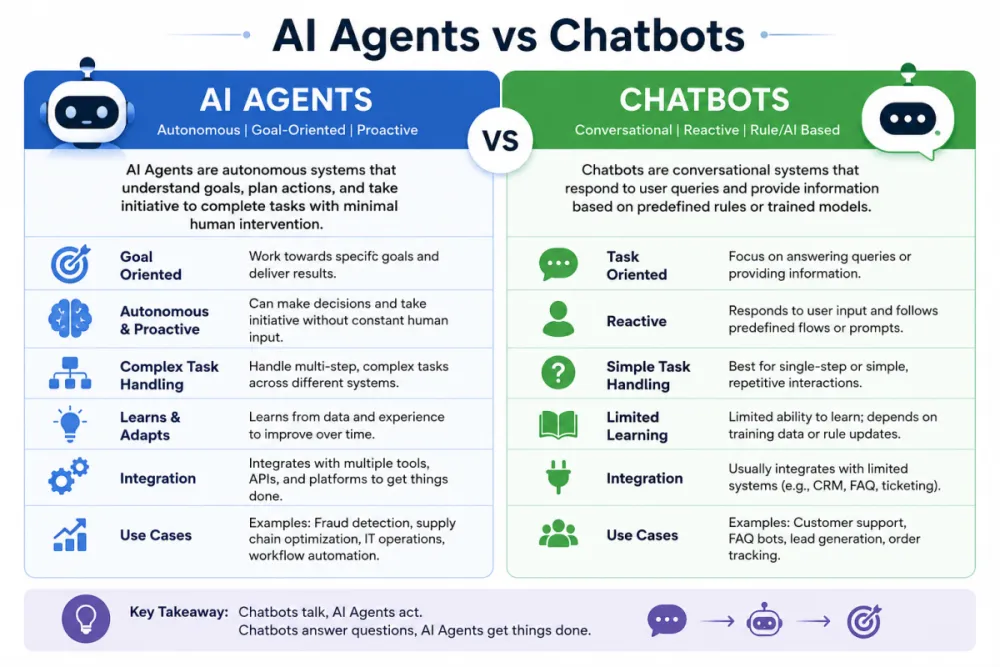
AI agents and AI chatbots are related, but they are not exactly the same. A traditional chatbot is generally designed to communicate with a user and provide a response. AI agent is designed to work toward a goal and may perform multiple actions during the process.
Feature
AI Chatbot
AI Agent
Main purpose
Answer questions
Work toward a goal
Interaction
Usually prompt and response
Can involve multiple steps
Tool usage
May have tool access
Often uses connected tools
Autonomy
Usually lower
Can be higher
Workflow
Often conversational
Often task-oriented
Human control
Direct interaction
Depends on the system
This does not mean AI agents are always better than chatbots.For a simple question, a chatbot may be faster and easier.For a multi-step work flow, an AI agent may be more useful.
Real-World AI Agent Examples
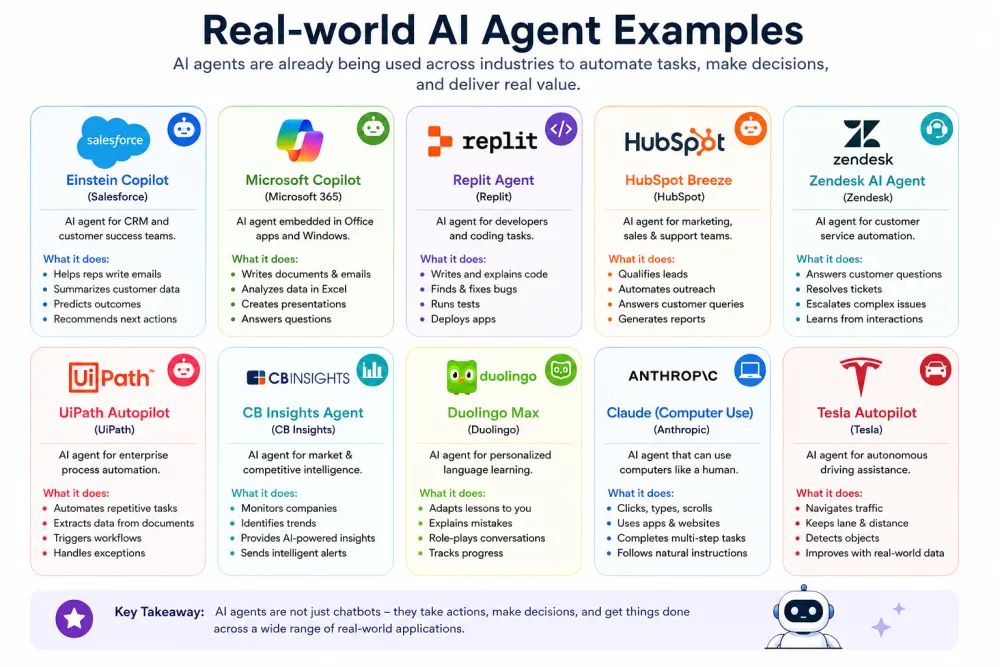
AI agents can potentially be used in many different areas.
1. Research Agents
Research-focused agents can help organize information from permitted sources.
* They may assist with:
*Topic research
* Information gathering
* Summaries
* Research notes
* Comparing information
However, important facts should still be verified before publication or decision-making.
2. Coding Agents
Coding agents can assist developers with software-development tasks.
Depending on the tool, they may help with:
* Understanding code
* Finding bugs
* Writing code
* Modifying files
* Running tests
* Explaining errors
Developers should review changes before using them in important projects.
3.Customer Support Agents
AI agents can assist customer-service teams by handling repetitive workflows.
ai agent example, an agent may:
* Classify a request
* Find relevant information
* Prepare a response
* Route complicated requests to a human.
4. Content Workflow Agents
Content creators can use agentic work flows for tasks such as:
* Topic research
* Content outlines
* Draft preparation
* Information organization
* Content checking
Human editing remains important because AI-generated content can contain mistakes or unsupported claims.
5. Data Analysis Agents
Some AI systems can work with structured data and connected analysis tools.
They may help users:
* Organize data
* Perform calculations
* Identify patterns
* Generate summaries
* Explain results
The accuracy of the final result should always be checked when the data is important.
Best AI Agent Tools for Beginners in 2026
Choosing the right tool is important for AI agents for beginners.The right tool depends on what you want to accomplish.When comparing an Choosing the right tools is important for AI agents for beginners, consider:
* What tasks it supports
* Available integrations
* Tool access
* Automation features
* Privacy controls
* Usage limits
* Human approval features
* Pricing
Some useful categories to explore include:
AI Agent Development Platforms
These platforms are designed for creating or integrating agentic work flows.
AI Assistants With Agentic Features
Some AI assistants are expanding beyond simple conversations and adding capabilities for completing multi-step tasks.
Coding Agents
These are designed specifically to help developers work with software projects.
No-Code AI Automation Tools
These can be useful for beginners who want to connect applications and automate repetitive work flows without extensive programming.
Important: AI tools change rapidly. Before publishing a list of specific tools, verify their current features, pricing, free-plan limits, and official documentation.
Free AI Agent Tools for Beginners
AI agents for beginners can start with free plans and limited trials.
Some AI services provide:
* Free plans
* Free trials
* Limited monthly usage
* Developer free tiers
* Limited agent features
However, “free” does not always mean unlimited. A free plan may have restrictions on:
Number of tasks Model usageTool access Automation runs Storage Advanced features Therefore, always check the current official pricing and usage limits before choosing a tool.
How to Choose the Right AI Agent
This simple process makes it easier for AI agents for beginners to get started.
1. Define Your Goal
Don't start by asking:
“Which AI agent is best?”vInstead ask:“ What task do I want the AI to complete?”
2. Check Tool Access
If your task requires web search, files, APIs, code, or another application, make sure the agent supports the required tools.
3. Check Permissions
Only provide the permissions necessary for the task. Giving an AI system unnecessary access can increase risk.
4. Look for Human Approval
For important actions, approval controls can help you review what the agent is about to do.
5. Check Privacy
Before uploading private or sensitive information, understand how the service handles your data.
6. Start With a Small Task
hoosing the right tool is important for
AI agents for beginners. should test an agent with a low-risk task first. Once you understand how it works, you can gradually move to more complex workflows.
Benefits of AI Agents
AI agents can provide several potential benefits.
Automation
They can help automate repetitive, multi-step workflows.
Time Savings
Automating repetitive tasks can reduce the amount of manual work required.
Tool Integration
Agents can combine AI capabilities with external tools and software.
Multi-Step Workflows
Instead of handling every step manually, an agent can potentially connect several steps into one workflow.
Productivity
AI agents can assist with research, coding, content workflows, customer support, data analysis, and other tasks.However, the actual benefit depends on the quality of the agent and how well the workflow is designed.
Limitations and Risks of AI Agents
AI agents are powerful, but they are not perfect.
They can:
* Misunderstand instructions
* Make incorrect assumptions
* Produce inaccurate information
* Use poor information
* Make mistakes while performing tasks
* Take unintended actions if permissions are poorly configured
For this reason, users should not assume that an AI agent is automatically correct simply because it can perform multiple actions.For important tasks, human review is still essential.
Are AI Agents Safe to Use?
AI-agent safety depends on several factors, including:
* The AI model
* The tools it can access
* The permissions provided
* The information it receives
* Security controls
* Human oversight
A good approach for beginners is to start with low-risk tasks.For example, you can first use an AI agent for organizing research notes rather than giving it unrestricted access to important accounts.For sensitive or high-impact activities, use strong approval controls and verify the results before taking action.
How to Use AI Agents as a Beginner
This simple process is a good starting point for AI agents for beginners.
Step 1: Choose One Simple Task
Pick a repetitive task that does not involve sensitive information.
Step 2: Define the Desired Result
Clearly explain what you want the agent to accomplish.
Step 3: Give Clear Instructions
Include important requirements, limitations, and expected output.
Step 4: Review Its Actions
If the platform provides approval steps, review them carefully.
Step 5: Check the Final Result
Do not blindly publish or use the result.Verify important information before relying on it.
AI Agents for Work
AI agents can be particularly useful for repetitive workplace workflows.
Examples include:
* Organizing information
* Preparing reports
* Research assistance
* Drafting documents
* Data processing
* Customer-support workflows
* Software-development tasks
The best use case is generally a task where the steps are reasonably well-defined and the result can be reviewed.
Students can also use AI agents as learning assistants.
Potential uses include:
* Organizing study material
* Creating revision plans
* Explaining difficult concepts
* Summarizing notes
* Generating practice questions
* Organizing research
However, students should use AI as a learning aid rather than submitting AI-generated work as their own when academic rules prohibit it.
What Is the Future of AI Agents?
AI agents are becoming an important part of the broader development of artificial intelligence.
The direction of the technology is moving toward AI systems that can do more than generate text.
They can increasingly interact with tools, applications, information sources, and workflows.
This could make AI more useful for everyday tasks.
At the same time, increased capability means increased responsibility.
As AI agents become more capable, areas such as:
* Security
* Privacy
* Permissions
* Human oversight
* Reliability
* Transparency
will become increasingly important.
Frequently Asked Questions
What is an AI agent in simple words?
An AI agent is a software system that can work toward a goal by planning steps, using available tools, and producing a result.
Are AI agents better than chatbots?
Not always. Chatbots are useful for conversations and direct answers, while AI agents can be more useful for multi-step tasks and workflows.
Can beginners use AI agents?
Yes. Beginners can start with simple tasks such as research organization, summarization, drafting, and workflow automation.
Are there free AI agent tools?
Some AI services provide free plans, trials, or limited usage. Features and limits vary, so check the current official information before choosing one.
Can AI agents replace humans?
AI agents can automate parts of some workflows, but they do not eliminate the need for human judgment. Human review is especially important for important, sensitive, or high-impact decisions.
Are AI agents safe?
They can be useful when properly configured, but safety depends on permissions, tools, security controls, and human oversight. Users should avoid giving unnecessary access and should review important actions.
AI agents for beginners can start with simple, low-risk tasks Instead of simply answering a question, an AI agent can be designed to work toward a goal, break a task into multiple steps, use available tools, and produce a final result.For beginners, the best way to learn AI agents is to start small. Choose a simple, low-risk task, give clear instructions, review the agent's actions, and verify the final result.As agentic AI continues to develop in 2026, understanding how these systems work—and how to use them responsibly—can help individuals and businesses make better use of AI while keeping humans in control.
For AI agents for beginners, starting with a simple task is a good approach.